Showing posts with label Others. Show all posts

Friday, July 31, 2015

Chess Software (Part 02)

Playing software

For beginners playing often (as in daily) is the best way of improving. Willing and able opponents are usually not readily available in any household and the computer (as an opponent) could be a reasonable substitute. For a number of years now some excellent playing software programs have been entering the market. 


The most popular in SA is perhaps the Fritz and the ChessMaster programs. Fritz is a more professional package aimed at the serious player and ChessMaster is aimed at the more social player who likes a good quality game on his computer. The chess playing programs all have “chess engines”, the part that calculates the moves, and some claim to be more “positional” and others more “tactically” programmed. Set on their strongest level, these programs can play close to GM strength on modern PCs.

Recently a few companies have been packaging multiple chess CD’s in one package. These might include a few chess teaching programs with older versions of the playing program.

The underachieving player may want to spar against a computer playing program, rather than lose face against stronger opponents in a classroom situation. When the coach wants to use the playing programs for maximum benefit he (and his students) will have to learn how to change the settings and choose the desired options from the drop down menus. Parents may be able to afford expensive software, but it is (like good chess books) of no use if not applied to improve the player’s chess skill.

While the coach can introduce a playing program and the correct settings for optimal training for an individual, it must be remembered that the program is just an aid to training. Children soon learn how they can ‘cheat’ the machine like limiting the thinking time or even play second best moves to trap the computer in a slow positional game where it plays weaker. The machine doesn’t mind, but this may also lead to an attitude of disrespect for his opponent or unwillingness to really think hard on a position. Playing human opponents helps a player to deal with side issues such as human behavior and reactions to his own behavior, forces the player to practice good chess etiquette and respect written and unwritten accepted social behavior. One of the coach’s biggest challenges is to get a six year old player to sit still and not talk while making the moves.


Chess Software (Part 01)


Visual Instruction

There is a wide range of electronic aids available to the chess coach and the chess learner. The coach/parent/teachers and players will benefit provided the CDs, DVDs or playing programs are used for the purpose it was designed. 

Players (especially the lazy ones) will look for “quick fixes” to help him to “win” a tournament or make the team. It is doubtful that such a “magic wand” exists – if chess was that easy why does it have such an extensive literature? To try and find short cuts is a (very) short sighted approach and though some initial success against other low level players may be inspiring, such an approach will not produce a good higher level player.

 The coach, when using a particular visual training aid must, when planning how to apply it, first decide what he wants to achieve by using it. Every student learns in a different way, some learn well by going over their games, others not. Some like to go over problems, but for others this may be pure drudgery. A good coach should find out which form of media the player(s) get the most value: books, CD’s, DVDs, audio tapes, flash cards, rhymes, etc. In a class with mixed levels of playing skill the coach, with the help of the chess teacher/supervisor may need to differentiate extensively and having a variety in chess training aids may help.
 For teachers starting out with chess at a school and a small budget to start off the large beginner classes, a video to introduce players to chess and in which all the basic chess moves are explained and illustrated may be very suitable. Remember that such visual lessons can be viewed over and over again by younger or older players, be used for retraining and also viewed by several classes at various stages. GM Susan Polgar produced a number of videos for the beginner chess player which can be a good substitute for a coach if the school cannot afford a professional coach every week. However, the teacher (in charge of organizing chess) should review the material beforehand and when planning the chess classes apply the principle of giving a little time for theory and a lot of time for practice. An hour long instruction video (or DVD) must be broken up into smaller sections (simply pause the CD/DVD if no logical stop was put in). The teacher must give time to practice the moves (which were illustrated on the video) on the real chess board. The video instruction certainly does not mean that the chess teacher can sit back and relax – quite the opposite - it should be merely an illustration of the planned lesson for the day. 
  Many good videos feature grandmasters, or seasoned instructors as presenters, they explain opening theory or endgame theory which might be fairly advanced in content and above the ability of lower level players. Typically, the coach that introduces an electronic aid will have to study the DVD first on his own and make an assessment of the content, the time required and the level of player that will benefit by it. An instructional video is not a “movie” that players view with popcorn and soda. The coach will prepare the students in advance and perhaps produce a paper with questions which can be answered only if the player paid close attention to the instructor on the video. The coach will probably play only a part of the video to highlight a specific discussion; further parts will be covered in further lessons, with the proper preparation.

 The greatest advantage of network software or visual instruction is when it supports learner participation. Loading, for instance, a tactics program on a school’s network can allow users in a class to log in with their respective IDs and complete a course over weeks or even months. Having students capture their games in electronic format is likewise a very effective way of distributing and working with information.

Tuesday, July 21, 2015

Best 5 Chess Android Apps


1. Chess.com - The app allows you to easily play live and daily chess, to solve puzzles, and to watch videos. It's not as richly featured as the chess.com site is, but the new beta version is bringing many, many more features to the app.


2. Follow Chess - This app allows you to follow lots of major super tournaments live and support was just added to easily view all previous rounds of a tournament. The UI is gorgeous and unique, and the games can easily be passed over to Analyze This for engine analysis.


3. Chess Book Study - Simply reading a Chess book without a Chess board is not easy. The app allows you to load in any chess book in pdf or epub format and play through the material with a split screen chess board. Not many people have pdf or epub chess books, but if you do, this is a must have app.


4. DroidFish Chess - DroidFish is an Android port of the very strong Stockfish chess engine, combined with a feature-rich GUI.  It is a very powerful, free engine. While it may not have the prettiest interface, it works very well and is quite full featured.


5. ChessOcr - This app utilizes the camera to recognize Chess Diagrams in books using optical character recognition (OCR). It allows you to use your phone to scan a chess diagram (book or computer screen) and import it into one of your other chess programs for saving or analysis. It is remarkably accurate and only takes seconds.

Wednesday, May 27, 2015

Chess History (for Kids)

Origin of the Game

  • In the 6th century A.D., when the Gupta Empire ruled in India, a game called Chaturaṅga was fast gaining popularity.
  • Chaturaṅga, translates as "four divisions (of the military)": infantry, cavalry, elephantry, and chariotry, represented by the pieces that would evolve into the modern pawn, knight, bishop, and rook, respectively.
  • The four divisions in Chaturaṅga (infantry, cavalry, elephantry and chariotry) are found in modern Chess.
  • Chaturaṅga was also played on a 8 x 8 board.
  • Both games are played with different pieces having different powers.
  • Victory depended on the fate of one piece, just like the king in modern chess.
  • When the game spread to Persia in the 7th century A.D., it began to be called Chatrang which changed with time to Shatranj.
  • The term Shah Maat to describe what is now known as Check mate also evolved at that time and it is the word 'Shah' meaning King, which is gradually believed to have evolved into the word 'Chess'.
  • Many people claim that Chess was first invented in their country including Russians, Chinese, Turks and Greeks.
  • However most scholars now agree that India gave birth to Chess through Chaturaṅga. 

Tuesday, April 21, 2015

Chess History

Part 01

To the transit of chess from India into Persia, next to Arabia and Greece, and by the Saracens into Spain; neither does a line appear as to Egyptian probabilities, or the nature of the game inscribed on edifices in that country. Though abounding in traditional names of Trojan heroes, and others equally mythical as regards chess, the more genuine ones of Chosroes of Persia, Harun, Mamun and Mutasem of Bagdad, Walid of Cordova, the Carlovingian Charlemagne of France, Canute the Dane, William of Normandy the English kings are entirely absent, nor is there a word concerning Roman games or the edict which refers to them in which Chess and Draughts (both mentioned) were specially protected and exempted from the interdiction against other games; which has escaped all writers, and would certainly, if known about, have been deemed of some significance.

The Persian and Arabian periods from the time of Chosroes, to Harun, covers the Golden Age of Arabian literature, which is more prolific in chess incident than any other; yet even this and Firdausi's celebrated Persian Shahnama, and Anna Comnena's historical work escapes notice. We may perhaps, not implicitly trust or credit, all we read of in some of the Eastern manuscripts biographical sketches; but there is much of reasonable narrative we need not discredit nor reject. We may feel disposed to accept, with some reservation, the account of the 6,000 male and 6,000 female slaves, and 60,000 horses of Al Mutasem,
(the eighth of Abbasside). 

The prodigious bridal expenditure, comprising gifts of Estates, houses, jewels, horses, described in the history of Al Mamun (the seventh of Abbasside, and the most glorious of his race), may seem fabulous to us;the extraordinary memories of certain scholars narrated in biographies, who could recite thousands of verses and whole books by heart may appear worthy of confirmation; the composition of two thousand manuscripts by one writer, and the possession of forty housand volumes by another,may somewhat tax our credulity.We may feel a little surprised to hear that Chosroes' chess men were worth an amount equivalent to one million of our money in the present day; we may doubt, or disagree with the opinions attributed to Hippocrates, or to Galen; that cures were effected, or even assisted of such complaints as diarrhea and erysipelas by the means of chess; or, that, as the Persian suggests it has been found a remedy of beneficial in many ailments from the heart ache to the tooth ache.

We may doubt whether the two Lydian brothers, Lydo and Tyrrhene, in the story of Herodotus really diminished the pangs of hunger much by it; but, amidst all our incredulity, we can believe, and do believe, that Chosroes and chess, Harun and chess, Charlemagne and chess, Al Mamun and chess, Canute and chess, are as well authenticated and worthy of credit, as other more important incidents found in history, notwithstanding that encyclopaediasts and writers down from the days of the Eastern manuscripts, the Persian Shahnama and Anna Comnenas history to the days of Pope and Philidor, and of the initiation of Sanskrit knowledge among the learned, never mention their names in connection with chess as exponents of which the Ravan, king of Lanka of the Hindoo law books, the famous prince Yudhisthira and the sage Vyasa of the Sanskrit, and Nala of the poems, and in more modern accounts, Indian King Porus, Alexander the Great and Aristotle, are far more reasonable names inferentially, if not sufficiently attested, than those cherished by traditionists such as Palamedes, Xerxes, Moses, Hermes, or any of the Kings of Babylon or their philosophers.

Wednesday, March 25, 2015

5 Great Chess Books For Kids


01. Chess for children 

by Murray Chandler & Helen Milligan


All the rules of chess are clearly explained, step by step, assuming no prior knowledge. The lessons are reinforced by the inventive tales that George is told by his pet alligator Kirsty, self-proclaimed Grand Alligator of chess.

02. Winning Chess Strategy for Kids

by Jeff Coakley


Designed for children 7 to 13 years old, Winning Chess Strategy is part of a series of beginner workbooks by Jeff Coakley. The workbook starts with the rules of chess and quickly progresses to strategic ideas like opening principles and piece development.
It also includes sections on tactical combinations, endgame technique, and middle game planning.

03. The Chess Kid's Book of Tactics 

by David MacEnulty


David MacEnulty, a former director of program development in New York City's award-winning Chess-in-the-Schools program, teaches students how to develop a tactical mindset. In The Chess Kid's Book of Tactics, he instructs 6-10-year-old players in how to recognize the basic chess patterns and how to apply those patterns to understand-and win-the game.
Read more


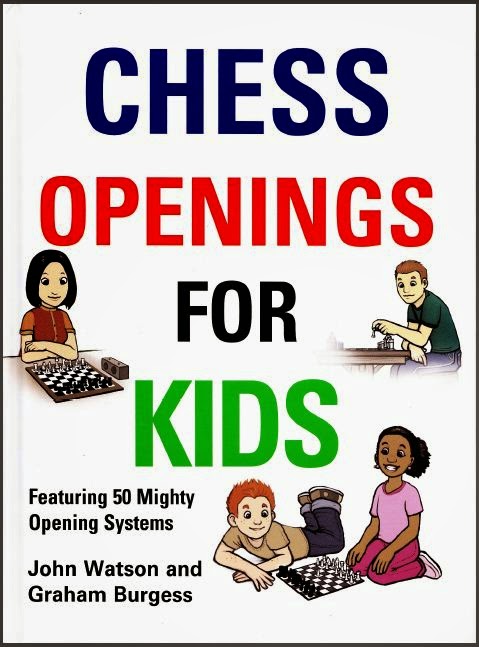
04. Chess Opening for Kids 

by John Watson & Graham Burgess


This simple guide provides all the tips and ideas needed to play purposefully from move one. That's because these 50 Mighty Openings are the very ones used by chess masters and grandmasters to outwit opponents time and again.
Read more


05. The Steps Method 

by Rob Brunia and Cor van Wijgerden


The Steps Method is really a full beginner’s chess course, featuring six training manuals and 20 workbooks. The course and books were developed from material by two Dutch chess teachers.


Friday, October 3, 2014

Welcome !


Chess Basic is best new chess news website. We published latest chess news from World and Asia. This site featuring tournaments, games and history as well as many Chess activities. Join with us!